The illusory truth effect
I’m a bit late with this, but here’s an interesting headline: “Liberal arts students have lower unemployment rates than computer science students according to the NY Fed”. It’s a headline I saw early last year, took a note to read further, and just rediscovered the headline when cleaning up my notes.
Here’s an article from The College Fix from June 20, 2025: Computer engineering grads face double the unemployment rate of art history majors. In the article, the author claims:
The stats show art history majors have a 3 percent unemployment rate while computer engineering grads have a 7.5 percent unemployment rate. Computer science grads are in a similar boat, with a 6.1 percent rate.
Ok, let’s find if this lines up with what NY Fed says:
| Major | Unemployment | Underemployment |
|---|---|---|
| Art history | 3% | 46.9% |
| Computer engineering | 7.5% | 17.0% |
| Computer science | 6.1% | 16.5% |
Oh, what’s that number next to “unemployment”? Uh-oh. Underemployment accounts for people working in a job which does not require a bachelor degree. This means that a computer engineering graduate is working a tech job, while an art history major takes up work in a fast food restaurant. And all of a sudden, the picture shifts. 17% of computer engineering majors were underemployed, while a whopping 46.9% of art history graduates weren’t utilizing their degree.
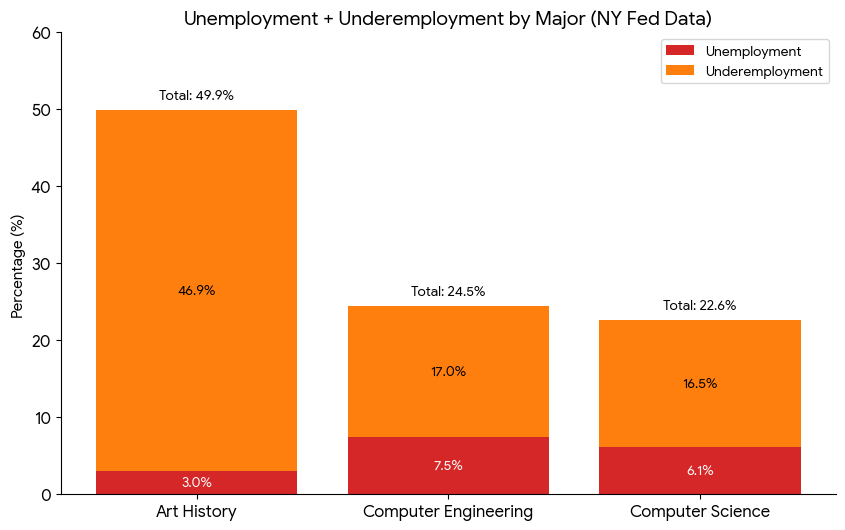
This article is one of many, which cherry-picked data from the NY Fed and made outrageous claims. Further, the data is from 2023, which the article above mentions near the end, in passing. That’s a pretty relevant bit, for an article written in 2025, isn’t it?
For me this brought up a question of digital hygiene and how the headlines I see affect us.
I have seen this headline many times throughout the year - I never read through content, but over time the headline stayed in my memory.
The illusory truth effect is the cognitive bias where repeated exposure to a statement makes it seem more truthful, even if it’s known to be false.
I really did believe that CS graduates had lower employment than art history majors. Don’t get me wrong, the job market for newgrads is oh-so-brutal, and the future prospects are murky. Which probably made it easier to believe such an outrageous claim.
Yes, disproving the headline took all of 10 seconds, but how many headlines do you see a day? What other misinformation cements itself in your head?
And ultimately, is it better to limit access to such information, or - however impractical - try to verify everything you see?